


BY LARABA JAURO
In Maiduguri, Borno State's capital, residents are finding it difficult to feed themselves, a situation now at an alarming rate.
In an interview with Lake Chad Times, the residents narrates how they struggle to afford daily feeding, even as one meal per day.
The situation is aggravated by the relentless surge in fuel prices, coupled with a myriad of economic challenges.
In communities like Maiduguri, where the combination of rising cost and limited food availability has pushed many to the brink of hunger, the situation has already ignited a looming food crisis.
This is more pronounced on the vulnerable population of internally displaced persons (IDPs) scattered within Maiduguri and it's environs.
Most of these IDPs are victims of flood disaster that ravaged Maiduguri in September, as well as victims of insurgency.
The price hike and its impact
'The price of food keeps on increasing everyday, we don't have options but to increase the prices of our products to buyers,' Garba, a rice seller, laments.
A bag of maize, once a staple, now cost N90,000, while a single measure ("mudu") is sold at N2,200.
The price of local rice is not an exception as 25kg is now priced at N35,000 and N70,000 for 50kg.
Modu Laminu, a maize trader at Custom Market, recounts the dramatic increase in prices of food.
Despite a slight decline from previous peaks, a mudu of maize still costs N2,200, a far cry from the N2,500 it was earlier.
According to Laminu, the price hike has drastically reduced his customer base, forcing many to seek cheaper alternatives like garri (cassava flour).
'Thank God now maize price has reduced compared to the previous weeks, but still many of my customers can't afford it,' he said.
Mohammad Aji, a small scale rice trader at Gamboru Market echoes Laminu's concerns.
He said he barely sells one bag of rice daily, compared to the three or more he used to.
According to him, the increase in cost of fuel and transportation is a significant factor in upsurge, making it difficult for both buyers and sellers.
The plight of internally displaced persons
The situation is particularly dire for IDPs, who often rely on meager daily wages to feed their families.
Amina Audu, a 50-year-old widow with nine children, struggles to make ends meet with her daily earnings of N2,000 from farm labour.
She said she cannot afford even a single mudu of maize with her earnings, let alone additional food supplements.
'I and my children go to bed with empty stomachs whenever I don't get a job at people's farm, because it is the only means we rely on,' she noted.
Like Yazama Bukar, many IDPs who used to receive government and NGOs assistance, are now left to feed for themselves in the face of soaring food prices.
'Over 10 years now we depart from our town. First we stayed in Arabic camp before coming here to Moforo camp. We used to receive help from government and NGOs but not any longer,' Yazama, aged 35, said.
Fatima, a mother of seven and resident of Ruwan Zafi area, described the hardship her family faces as disastrous.
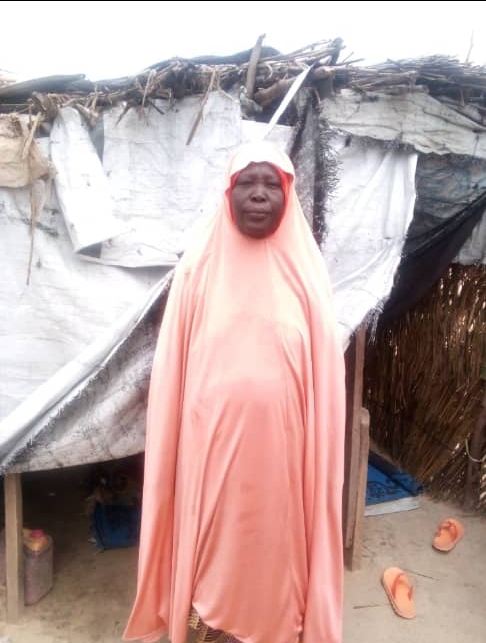 Photo credit: Laraba Jauro
She explained that her husband can no longer afford two square meals a day for the family.
'I am afraid of the price of goods in the market. I really don't know how the future will be and I don't know if we can feed our children or not because of the stage we are in now,' Halima, a concerned resident, expresses.
This sentiment is shared by many in Maiduguri, who are grappling with the harsh realities of rising food prices.
The impact is forcing many to resort to desperate measures for survival, including reducing meal sizes, skipping meals altogether, or consuming cheaper but less nutritious food.
This is however leading to malnutrition, particularly among children and the elderly.
Interacting with several market traders, Laminu like others, believes that over 70% of residents in Maiduguri cannot afford three square meals a day.
This alarming statistic highlights the severity of the food crisis and the urgent need for intervention.
The urgent need for government action
The government has been urged to take immediate action to address the crisis.
Residents are calling for a reduction in fuel prices, which is considered the primary driver of the overall cost increase.
Additionally, there is a need for increased support for IDPs and other vulnerable populations to help them cope with the rising cost of living.
The food security crisis in Maiduguri is a stark reminder of the interconnectedness of food, fuel, and economic stability.
Unless urgent measures are taken, the situation is likely to worsen, leading to further suffering and instability in the region.