

BY ADAMA ADOMAI, AUGUST 17, 2026 | 12:09 PM
Fatima stayed up until dusk waiting for the University of Maiduguri’s hostel portal to open.
She wanted a bed space at Ali Monguno Hall, but spent hours staring at a loading screen, and by the time the portal responded, every bed space was gone.
'I couldn’t get a space,' she recalled during an interview.
Without an alternative, Fatima spent her first semester living off campus in Bulumkutu area, a community in Maiduguri, far away from her school. Moments later, transport costs went up, her attendance dropped, and her grades suffered.
Fatima eventually paid N65,000 to buy a bed space from another student, more than twice the official university fee.
'The online booking system is actually fair because everyone has an equal chance,' she said, adding that, the real problem is there simply aren’t enough spaces.
In Unimaid, the single biggest struggle for students is finding accommodation, because Fatima’s story is the norm, not the exception, especially for those coming from other states and far away communities.
This raises the question, whether the core problem is lack of enough bed spaces or other issues all together.
An investigation by this reporter across Unimaid hostels reveals another dimension.
The university officially charges between N15,135 and N22,635 per session and because demand far outweighs supply, a black market has exploded.
Students who miss out on the portal now pay between N65,000 and N120,000 to buy bed spaces from other fellow students succeeded on the application.
The university admits allocations are competitive every session and with enrollment rising and hostel infrastructure aging, the gap keeps widening.
However, even in midst of the struggles of get accommodation in hostels, some students prefer to stay off-campus due to conditions of the hostels' facilities.
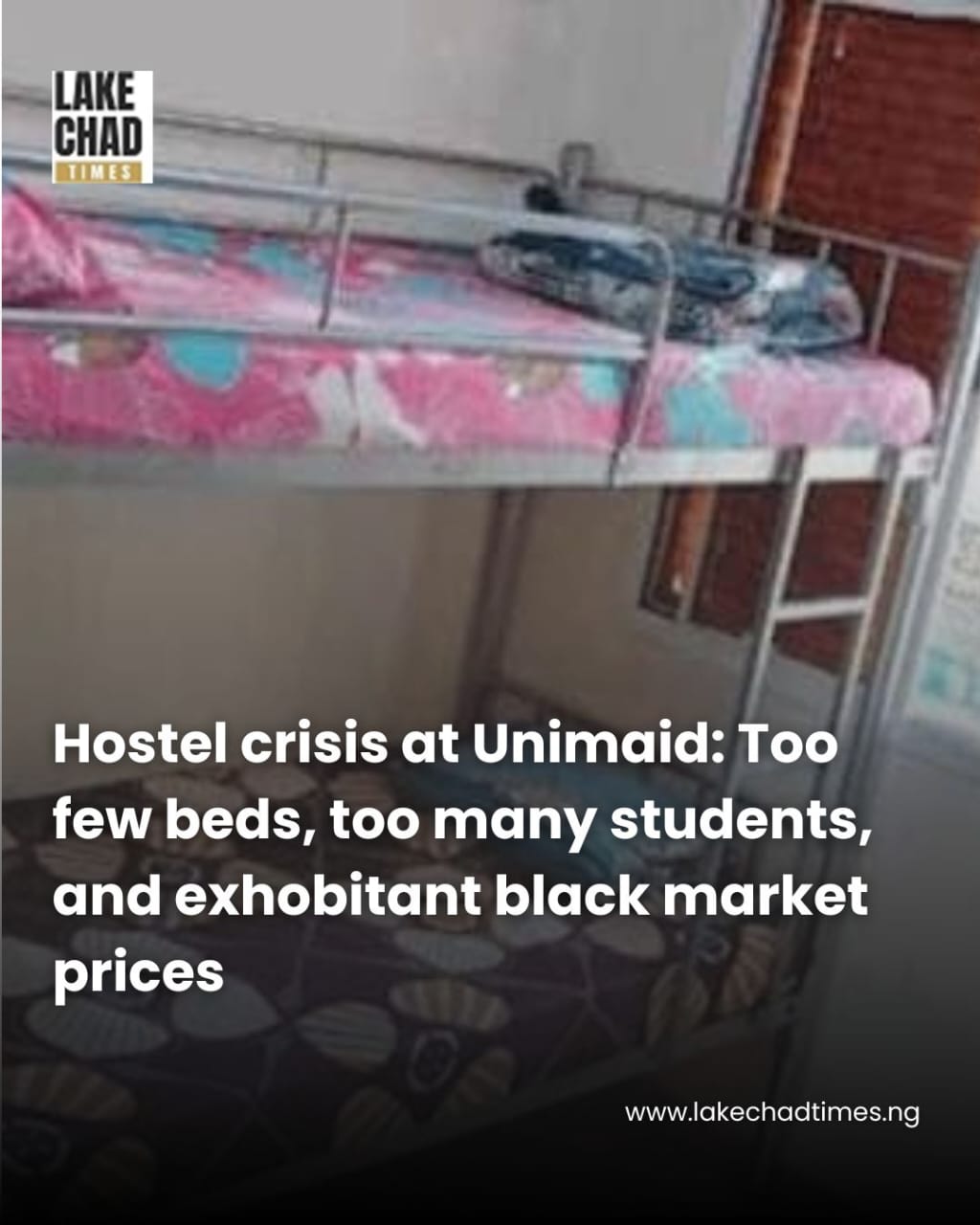
The oldest hostels; Titanic, Murtala Mohammed Hall, and Aisha Hall were built decades ago for four students per room. Today, they house far more.
Kabir, a 300-level student in D Block, said the facilities have broken electrical sockets, faulty fans, leaking roofs, damaged toilets, poor drainage, and inadequate fumigation.
He added that water shortages is also common during peak periods.
'The hostels are old, and some of the facilities have simply outlived their usefulness,' he said.
Photos obtained from D Block show dilapidated toilets with no maintenance plan.
For students living with disabilities, the situation is worse as most hostels have staircases and facilities that are not accessible.
Rabi, a 400-level student, bought a bed space only to have it revoked after the room was converted to store mattresses. She spent a semester off campus before finding another space this time in a room with no fan and mosquitoes everywhere.
'There was no fan, mosquitoes and insects are everywhere in the room, but I accepted it because I had nowhere else to stay,' she said.
At Unimaid, squatting and buying bed spaces are officially prohibited, but when options are limited, students say they have no choice.
According to the 2026 hostel allocation timetable, thousands of students rush the portal once it opens and booking closes within hours, while unpaid spaces are revoked after two weeks.
Beyond overcrowding and the growing black market for hostel bed spaces, several students questioned why some rooms appeared fully booked on the school’s online portal, yet remained unoccupied weeks after students resumed on campus.
The allegation has fuelled speculation among students that certain rooms are deliberately withheld from the booking system and reserved for a select few, “VIP rooms" they call it.
One student, who spoke on condition of anonymity, said she first noticed the issue after unsuccessfully trying to secure accommodation through the university’s online portal.
Beyond her personal experience, she questioned what she described as the recurring appearance of empty rooms after the hostel allocation process had officially ended.
'Sometimes the portal shows that certain space is occupied. But when school resumes, you see rooms that are empty and we don’t understand why. Some of us cannot afford to stay off campus because of the economy. If those rooms are truly available, they should be put on the portal,' she explained.
Responding to questions in an exclusive interview, the Dean of Student Affairs, Professor Ahmadu Muhammad Brono, said revocations are meant to free up spaces for students ready to pay.
He also noted that a limited number of bed spaces are reserved for “unforeseen official needs."
He however denied allegations of “VIP rooms” being held empty, and said some apparently vacant rooms are undergoing maintenance as well as for other necessities.
According to him, hostel allocations are conducted electronically, making the process transparent for all students.
'If the Vice-Chancellor or another principal officer requests accommodation for a student under special circumstances, that request comes through my office,' he said.
He maintained that students accommodated through this arrangement still pay the same official hostel fees as every other student.
Professor Brono further explained that some rooms students perceive as deliberately left vacant are actually undergoing maintenance.
According to him, where repairs become necessary, occupants are temporarily relocated to the reserved bed spaces until renovation is completed.
He also linked some of the maintenance challenges to overcrowding caused by squatting.
'When a room meant for four students ends up housing eight or ten people, naturally the facilities deteriorate faster,' he said.
Stating further, the deen said that 'funding remains one of the university’s biggest constraints.'
He also noted that, to ease the problem of accommodation, the university is currently constructing two additional hostels with modern sanitary conveniences.
Findings suggest that Unimaid also charges among the lowest hostel fees of any federal university, yet students argue that affordability means nothing without availability.
Housing problem is a national crisis in Nigeria and a local emergency for institutions like Unimaid.
The school's housing deficit reflects a wider problem in Nigeria’s tertiary institutions.
In May 2026, the Federal Government announced a N250 billion intervention for student hostels across at least 50 institutions.
Each school is expected to get about N2 billion for at least 500 bed spaces, with an additional N90 billion for PPP projects in 24 federal institutions.
For Unimaid students, that intervention cannot come fast enough, and until new hostels are completed, students will continue to choose between expensive off-campus rent, risky black market deals, or overcrowded rooms with failing facilities.
Editor's Note: This story was produced under a collaborative fellowship programme between Yerwa Express News (YEN), Lake Chad Times, and the Union of Campus Journalists (UCJ), University of Maiduguri.