

BY NEWS EDITOR, NOVEMBER 26, 2026 | 04:32 PM
With over 1.8 million learners enrolled, 5,792 usable classrooms and functional Senior Secondary Schools rising from 34 in eight local government areas in 2019 to 129 in 2026, Borno State Government said it is using education to bring Almajiri and out-of-school children into the formal system.
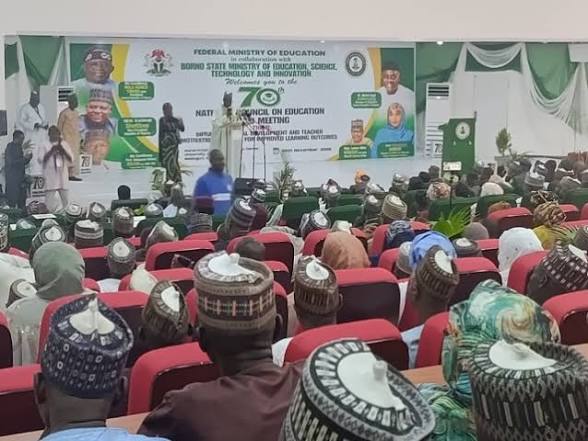
Governor Babagana Umara Zulum disclosed this on Thursday during the 70th National Council on Education held at University of Maiduguri.
He said the state has established 27 Higher Islamic Colleges to bring Almajiri and other out-of-school children into formal education, with 20 completed and seven nearing completion.
He commended the Federal Government for its education reforms in teachers' welfare, technical education, girl-child education and efforts to reduce out-of-school children.
The governor praised President Bola Ahmed Tinubu for the reforms, acknowledging the increase in university lecturers' welfare and the introduction of free technical education.
He said strengthening Technical and Vocational Education and Training (TVET) institutions would bridge the gap between graduates' skills and labour market demands, noting that Borno had established several technical and vocational institutions.
On teachers' welfare, Gov. Zulum said his administration was building 100 units of teachers' quarters in Bama, Gubio, Biu, Hawul, Askira-Uba and Dikwa, to encourage teachers to serve in rural communities.
He added that additional incentives would soon be introduced for teachers in difficult areas, stressing that teacher motivation was essential to improving learning outcomes.
On girl-child education, the governor said the Higher Islamic Colleges were a deliberate strategy to integrate Almajiri children into the formal system while preserving their Islamic learning.
He commended NELFUND, saying the University of Maiduguri had benefited from about N600 million, which helped students pay school fees.
He urged the Federal Government to address the shortage of qualified teachers, strengthen school security and sustain funding for safe learning environments, while calling for better federal-state coordination.
Gov. Zulum also commended the Federal Government for supporting the establishment of the Federal College of Education in Gwoza and the Federal University of Agriculture and Entrepreneurship in Bama, as well as the revival of bilingual schools.
In his remarks, the minister of education, Dr. Tunji Alausa, said the council provided an opportunity for policymakers to review progress, address challenges and agree on practical measures to improve education nationwide.
He explained that under the Renewed Hope Agenda, the Federal Government had introduced six major education policies covering foundational literacy and numeracy, inclusive education, alternative learning pathways, Almajiri education, non-state schools and re-entry of pregnant and married adolescent girls.
He disclosed that 552 million dollars had been secured through the HOPE-EDU programme, with World Bank and Global Partnership for Education support, to improve basic education.
He added that the AGILE programme had been expanded from 18 to 21 states to improve girls' access to secondary education.
Alausa called on state governments and stakeholders to strengthen school infrastructure, improve teachers' welfare and ensure every Nigerian child has access to quality education.